PORTFOLIO 

Brand &
Creative
Strategy

I turn business objectives into creative systems: briefs, campaigns, reports and spaces that scale across channels, teams and regions.

11+ YRS Creative directionCampaign systemsBrand governanceExperience design
Open to Brand & Creative Lead roles
12%Increase in brand awareness tied to flagship reports
83Net-new paid creatives shipped in a single month
9%Audience growth from digital & social initiatives
6%Lift in engagement rate
5+In-house and contract designers led and mentored
Selected work

Case studies

Four projects, each told from problem to outcome, with the full set of supporting artifacts.

Also

Graphic archive

Identity, social, print and illustration work from freelance and earlier roles.

Case study 01 / 04
01.

Persona-Led Campaign Brief Builder

From scattered requests to one source of truth for every campaign.

CompanyCodecademy (Skillsoft)
DisciplineCreative strategy · Process design
My roleIdentified the problem, designed and built the solution end to end
Built withClaude Design
Challenge

Briefs reached creative incomplete and fragmented. Channel and resource decisions happened too late.

Strategy

A persona-first brief builder that captures every campaign requirement once, in one place.

Outcome

Briefs complete on first submission, with fewer clarification rounds after kickoff.

01 — Context

Campaign and marketing briefs were reaching the creative team incomplete and fragmented. Each stakeholder had different priorities, but requirements weren’t consolidated anywhere.

The team spent time clarifying instead of creating, and channel and resource decisions happened too late in the process.

02 — Insight
The brief wasn’t missing information. It was missing a shared starting point. Start every brief from the audience, and goal, tone and channels follow.
03 — Approach
Survey insights→ Personas→ Brief builder→ Creative brief→ Production
1

Start with the audience, not the asset

Every brief is anchored in three learner personas derived from audience survey research. Picking a primary (and optional secondary) persona drives the goal, tone and channel recommendations for the rest of the brief.
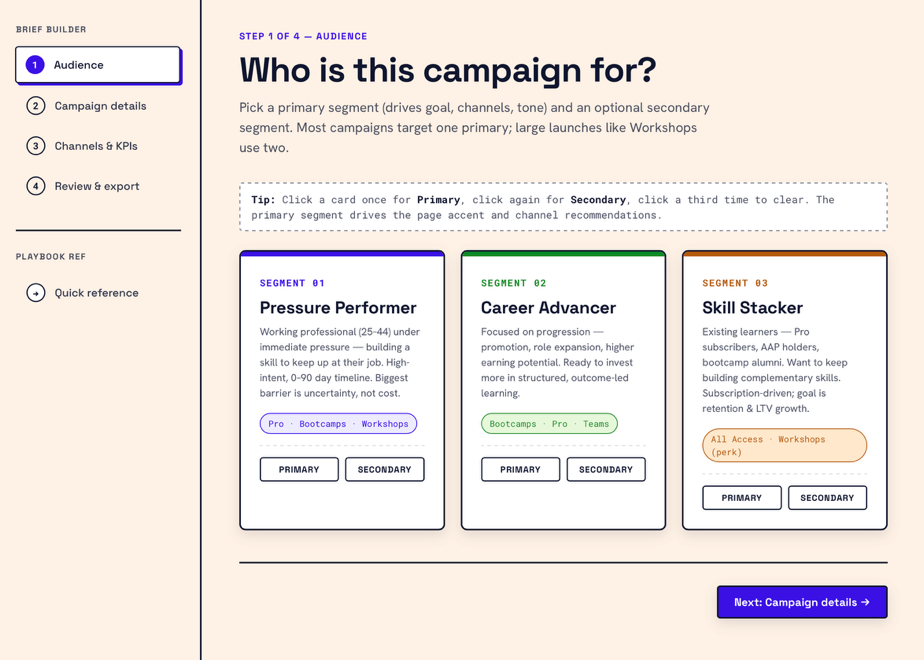
Pressure PerformerProfessionals on a 0–90 day timeline. Biggest barrier: uncertainty, not cost.
Career AdvancerFocused on promotion and ready to invest in structured learning.
Skill StackerExisting learners adding skills. Goal: retention and lifetime value.
Persona selection
Fig 1.1 — Audience selection: the three persona cards
2

Capture campaign details once

All specifics live in one place: name, product, launch date, live window, offer, primary CTA and goal, plus positioning and messaging: core message, role-specific variants, value propositions and proof points.
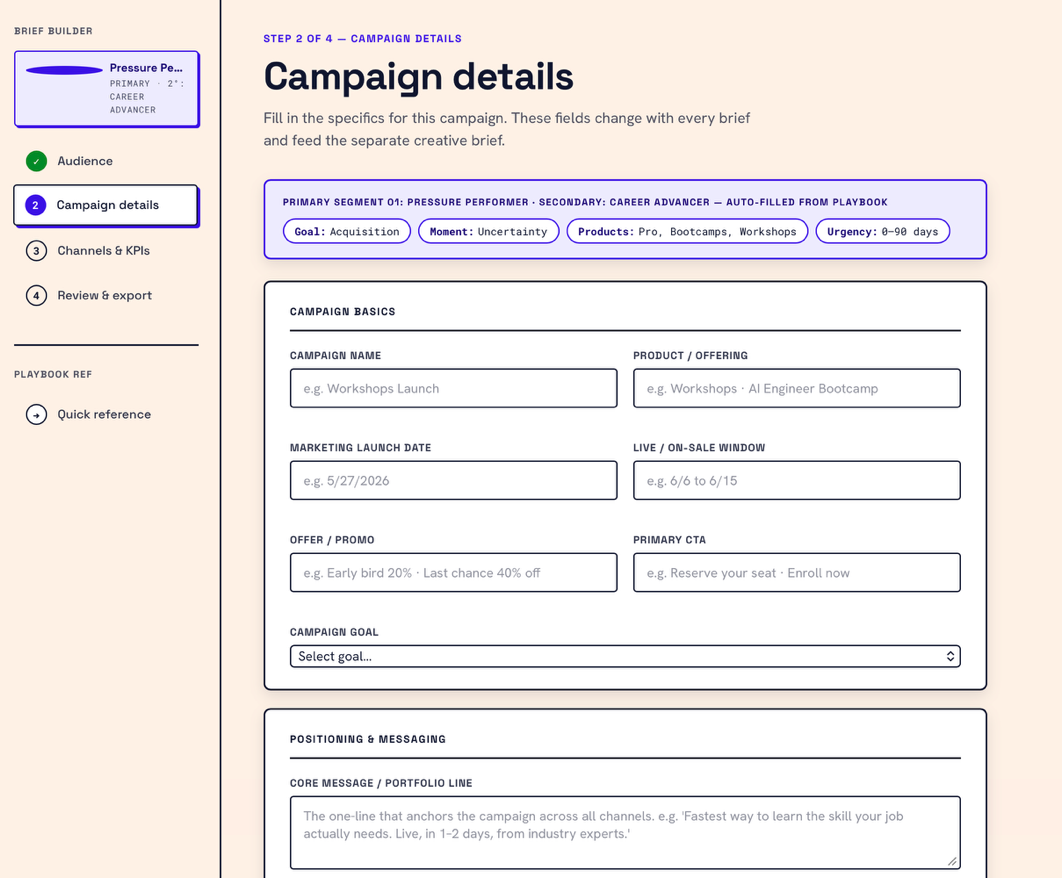
Campaign details
Fig 1.2 — Campaign details
3

Decide channels and owners early

Channels are pre-selected from the primary persona across email, on-site, paid social, paid search and organic social. Each gets an owner and emphasis guidance, so accountability is set before production starts.
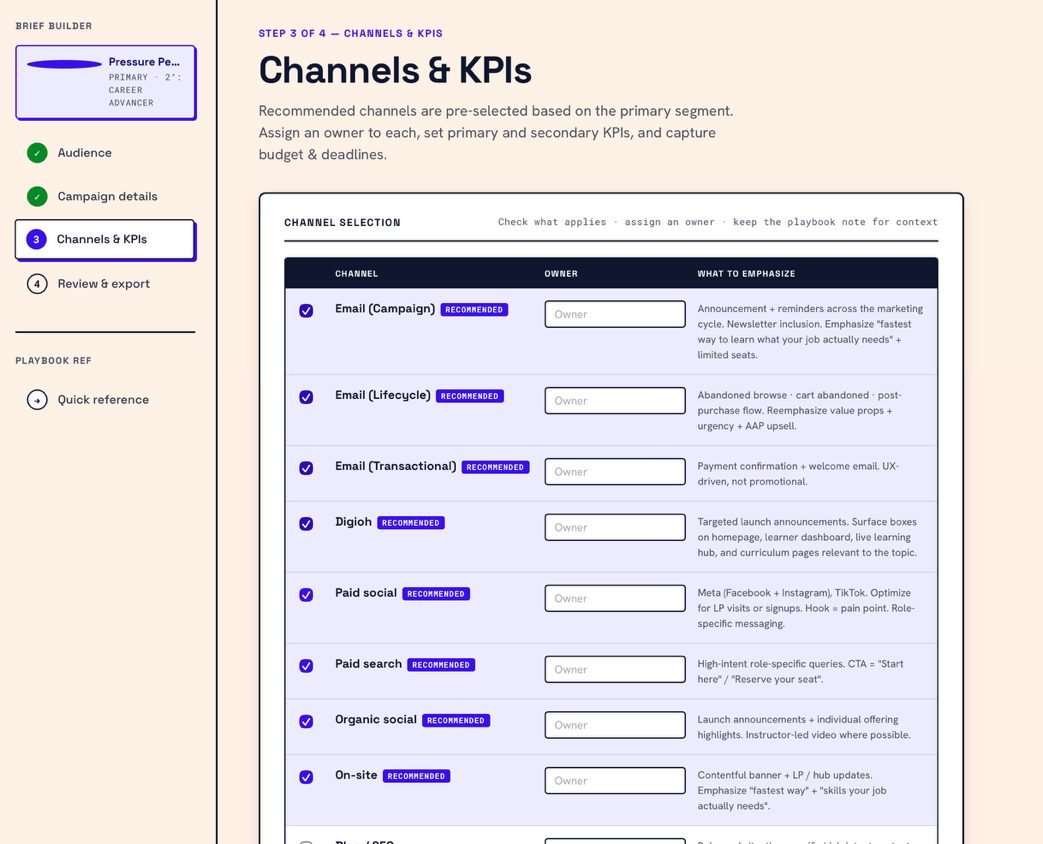
Channels and KPIs
Fig 1.3 — Channels and KPIs with owners
4

Review, export, hand off

Everything consolidates into one review page that exports as a PDF. Once approved, it feeds the Creative Brief: headlines, visuals, formats and tone guardrails.
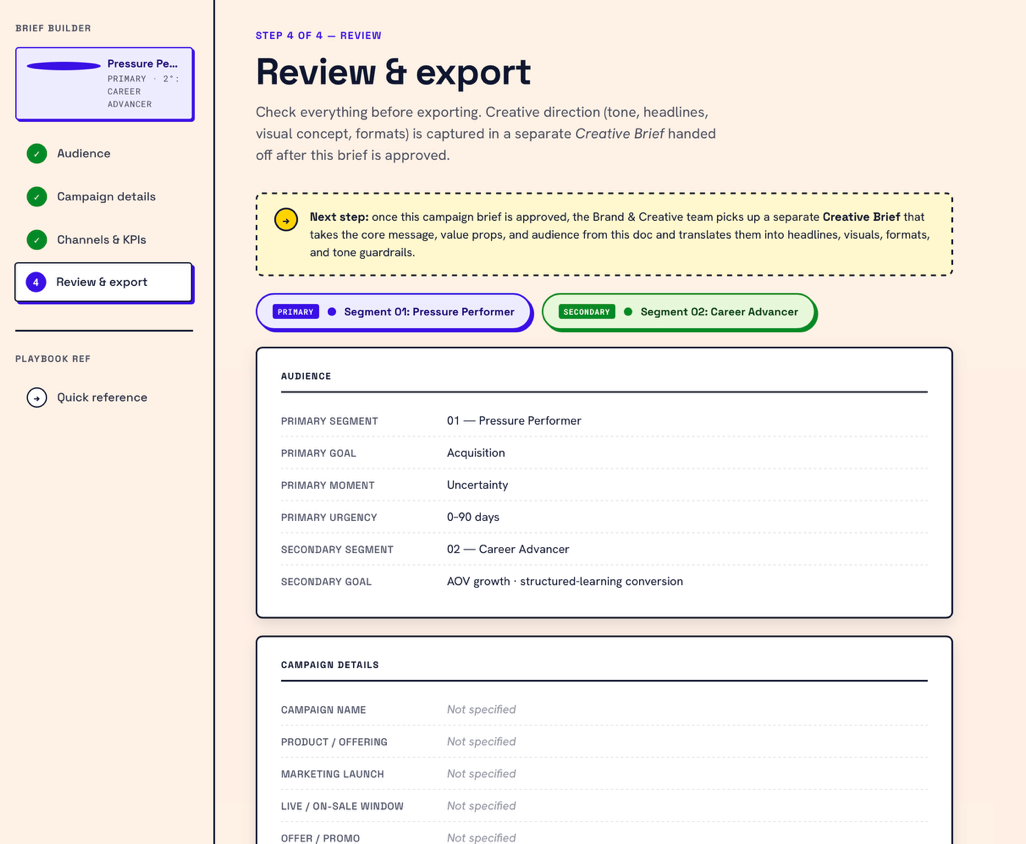
Review and export
Fig 1.4 — Review and export
04 — Artifacts
{{ a.cap }}
{{ a.cap }}
05 — Outcomes
First-time-rightBriefs complete on first submission
Fewer roundsFewer clarification and revision rounds after kickoff
Faster startTime saved from brief to creative start
Case study 02 / 04
02.

Creative Experimentation
at Scale

From individual assets to a connected creative ecosystem.

CompanyCodecademy (Skillsoft)
DisciplinePaid creative strategy · Testing framework
My roleCreative direction and experimentation approach
ChannelsPaid social · Email · Display · Landing pages
Challenge

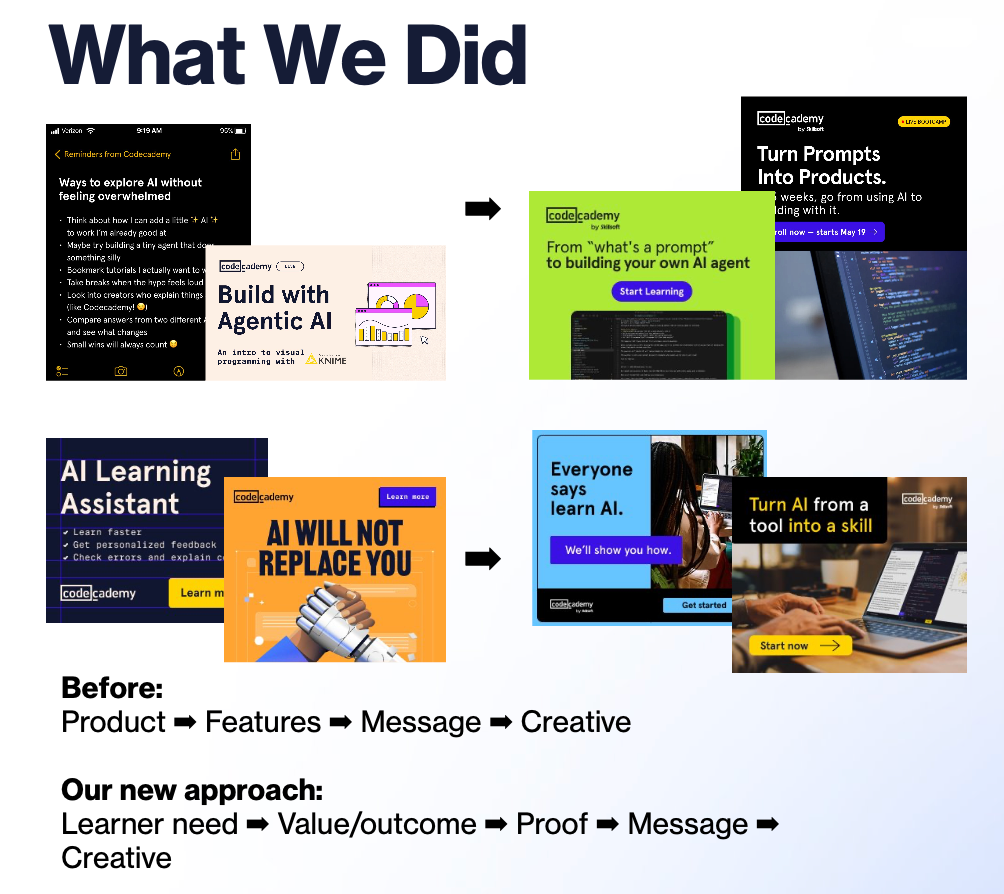
Paid creative was built one asset at a time, led by product features, on an algorithm that kept changing.

Strategy

Lead with the learner’s need, test distinct creative signals and formats, and package winners across every channel.

Outcome

A repeatable system running at volume: 83 net-new creatives in July alone.

Creative signals
01 — Context

Paid creative was being built one asset at a time and led by product features. Meta’s algorithm kept evolving, so relying on a single creative formula was risky.

The team needed a structured way to learn what actually resonates with learners, and to carry a winning message consistently across every touchpoint.

02 — Insight
Learners respond to their own problem, not a product’s features. And no single formula survives an algorithm that keeps changing.
03 — Approach
1

Flip the creative starting point

BeforeProduct→Features→Message→Creative
AfterLearner need→Value / outcome→Proof→Message→Creative
“AI will not replace you.” → “Everyone says learn AI. We’ll show you how.”
Messaging shift
Fig 2.1 — Before → after messaging shift
2

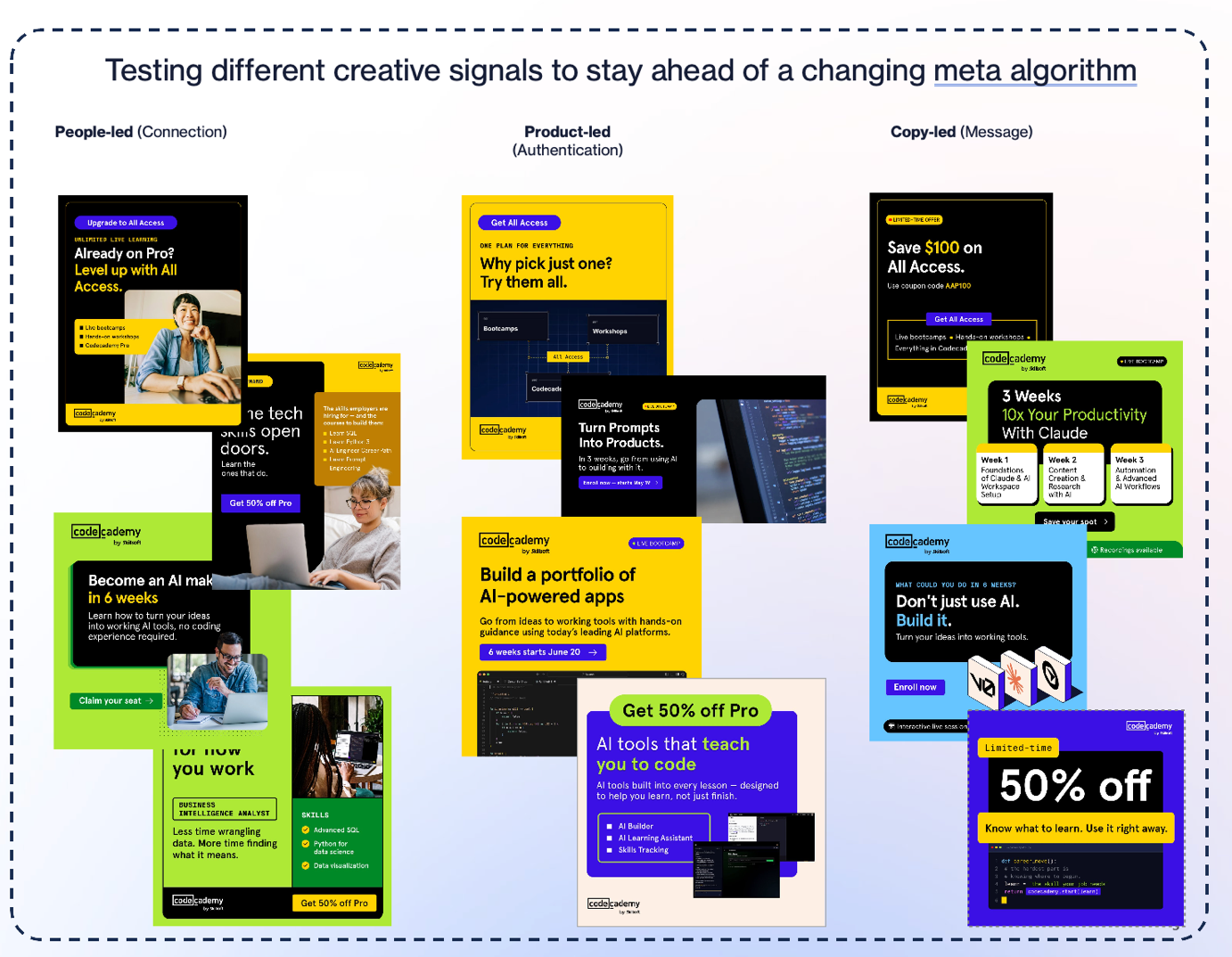
Test distinct creative signals

Rather than repeating one formula, three approaches ran side by side.

ConnectionPeople-ledRelatable, audience-aligned imagery that builds emotional connection.
AuthenticationProduct-ledReal product UI that shows the actual learning experience and builds trust.
MessageCopy-ledReduced visual complexity so the value proposition does the heavy lifting.
3

Test formats, not just visuals

One message, expressed across four formats. Holding the message constant while changing the format shows what is actually driving engagement.

One message
Static→ Carousel→ Animation→ Video
Continuous loop
① Test② Measure③ Learn④ Optimize ↺
4

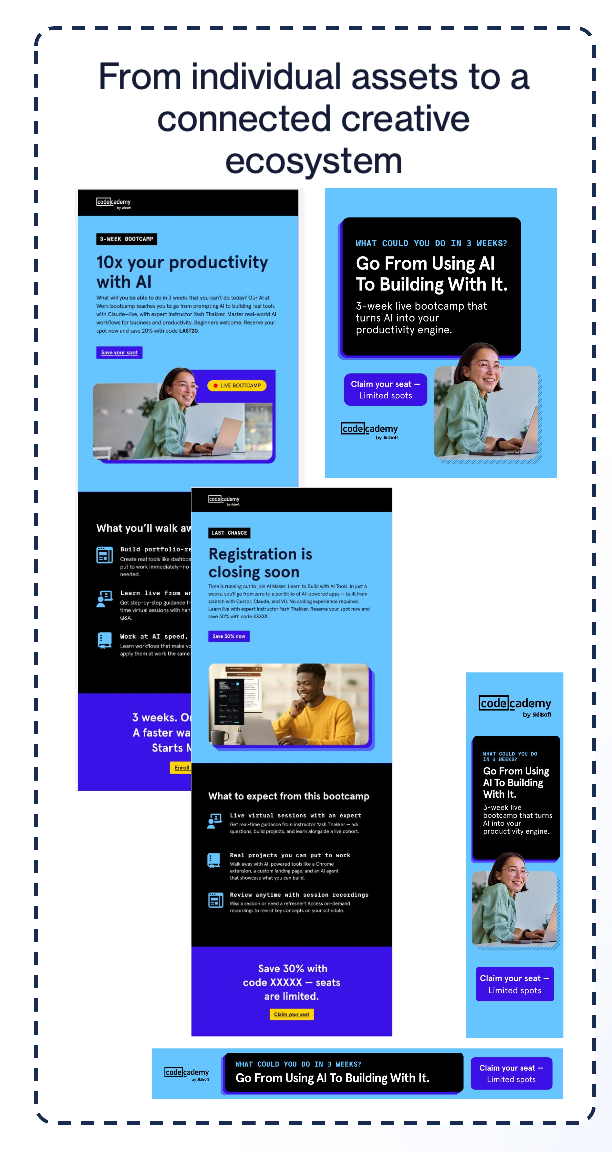
Build connected campaign packages

Each core message is translated across email, paid social, display and landing pages, so learners get one consistent experience. The 3-week AI bootcamp, “Go From Using AI To Building With It,” ran through email, social and every display size.

Connected ecosystem
Fig 2.2 — Connected creative ecosystem: AI bootcamp campaign
5

Make it repeatable

Requirements were aligned before kickoff so ideas could be pitched early. Asana tracked subtasks and routed feedback, and copy and creative were developed together rather than one after the other.

04 — Artifacts
{{ a.cap }}
{{ a.cap }}
05 — Outcomes
83Net-new creatives in July alone, across static, carousel, video and landing-page video
Learner-first winsLearner-need creative tested against the old product-led approach
Format findingsCarousel and video outperformed static on some messages
Learning

Leading with the learner’s need consistently produced stronger, more transferable creative. Because the framework holds the message constant while changing the format, the team learns why something works, not just that it worked.

Case study 03 / 04
03.

Annual Reports
as Year-Round Campaigns

Turning flagship research reports into a full marketing ecosystem.

CompanySkillsoft
DisciplineBrand & editorial design · Campaign packaging
My roleDesign lead, concept to delivery; owner of the campaign package
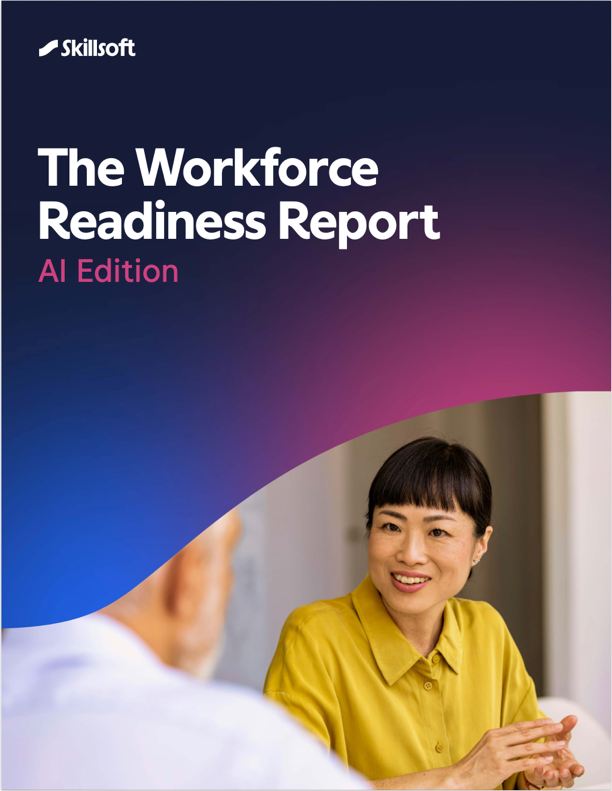
ReportsITSSR · Women in Tech · Lean Into Learning · CSR · Workforce Readiness and many more...
Challenge

Flagship reports had to feel current, consolidate many teams’ input and ship on tight timelines, then keep working all year.

Strategy

Design each report as a campaign, not a document, with assets planned for every stage of its life.

Outcome

Supported brand initiatives tied to a 12% increase in brand awareness.

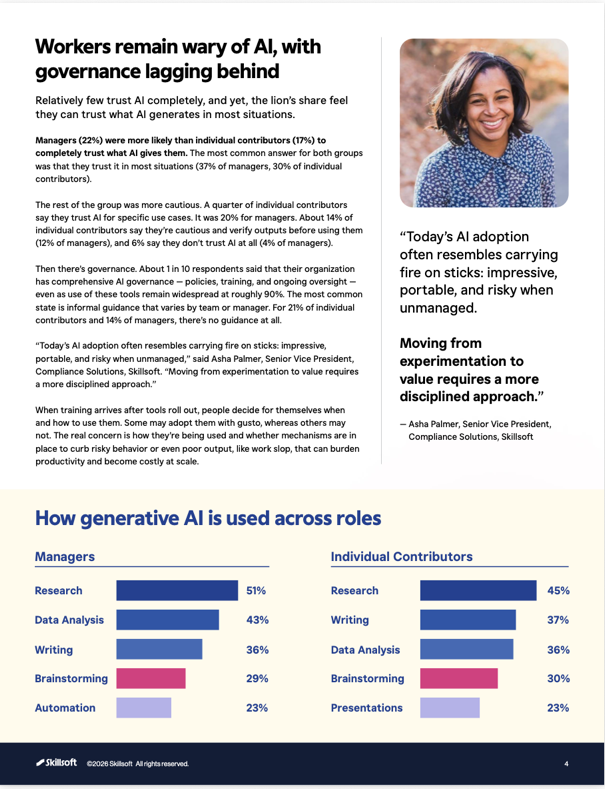
WRR cover
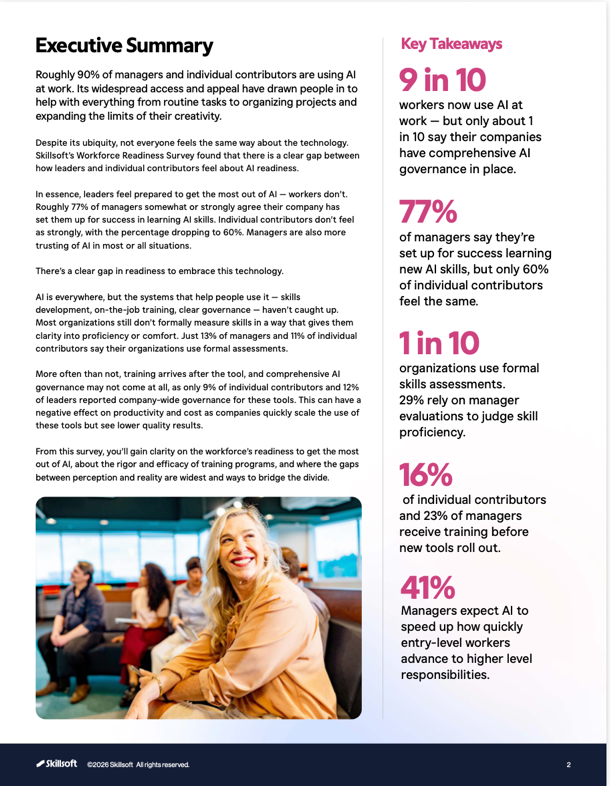
WRR summary
WRR data spread
01 — Context

The company’s flagship annual reports weren’t one-off publications. Each became a core marketing asset used across channels for the entire year.

That raised the stakes. Every report had to reflect current design trends, consolidate input from many teams, ship on a tight timeline, and be built so its content kept working long after launch.

02 — Insight
The report is the center of the campaign, not the end of the project.
03 — Approach
1

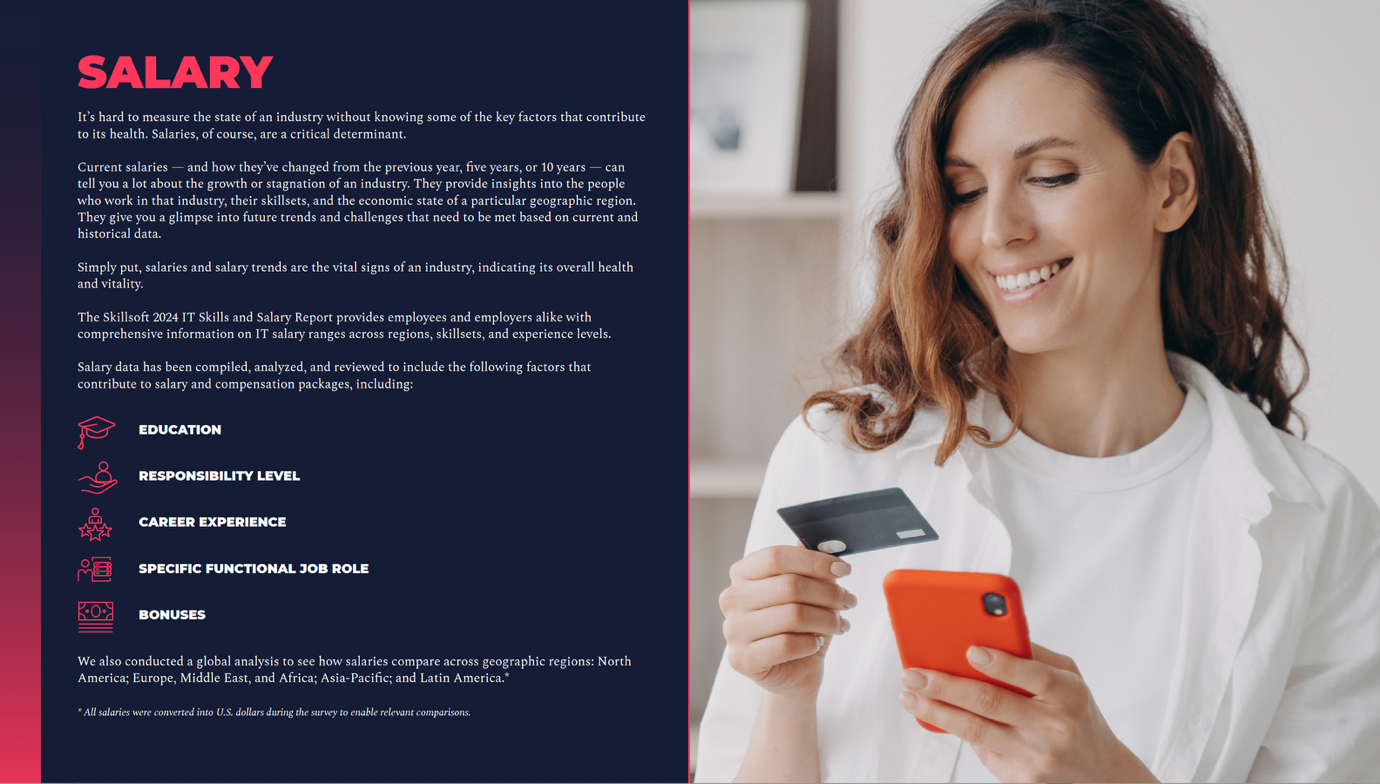
Concept each report around a theme

Each edition starts with a theme shaped by current design trends, so it feels fresh while staying on brand.

ITSSR cover
Fig 3.1 — ITSSR 19th edition cover
ITSSR salary
Fig 3.2 — Section opener carrying the theme
2

Orchestrate cross-functional collaboration

Content, analytics, survey and stakeholder teams all fed into each report. I consolidated their feedback into a single creative direction, which kept reviews moving and protected the timeline.

3

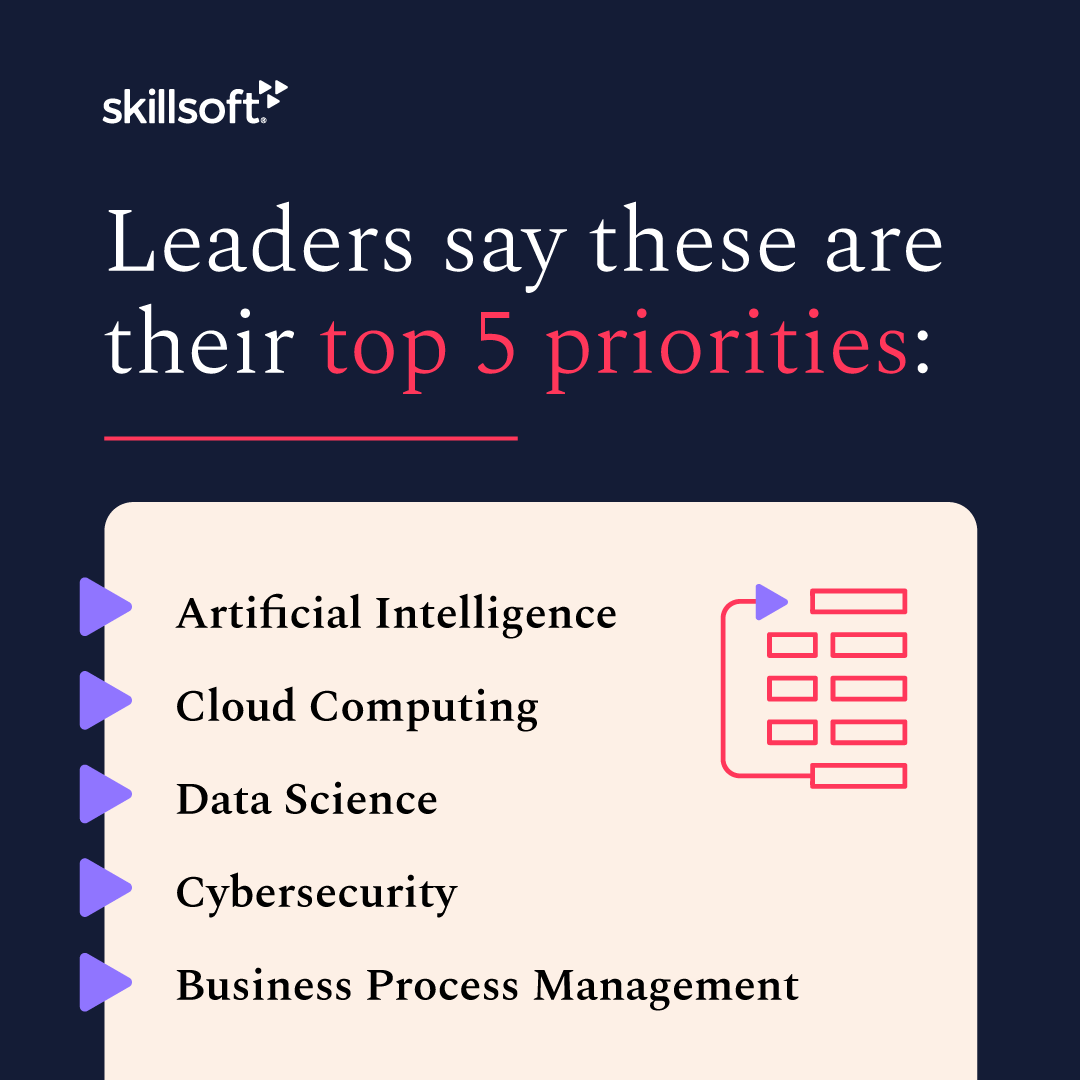
Design the report as a campaign

● Pre-launchTeasers and promo social to build anticipation
● LaunchRelease assets across channels
● Post-launchFollow-up assets that sustain momentum
● Year-roundReport sections repurposed as standalone assets
Social post
Social post
Social post
Email banner
Fig 3.3 — Launch email banner
One-pager
Fig 3.4 — One-pager derived from the report
4

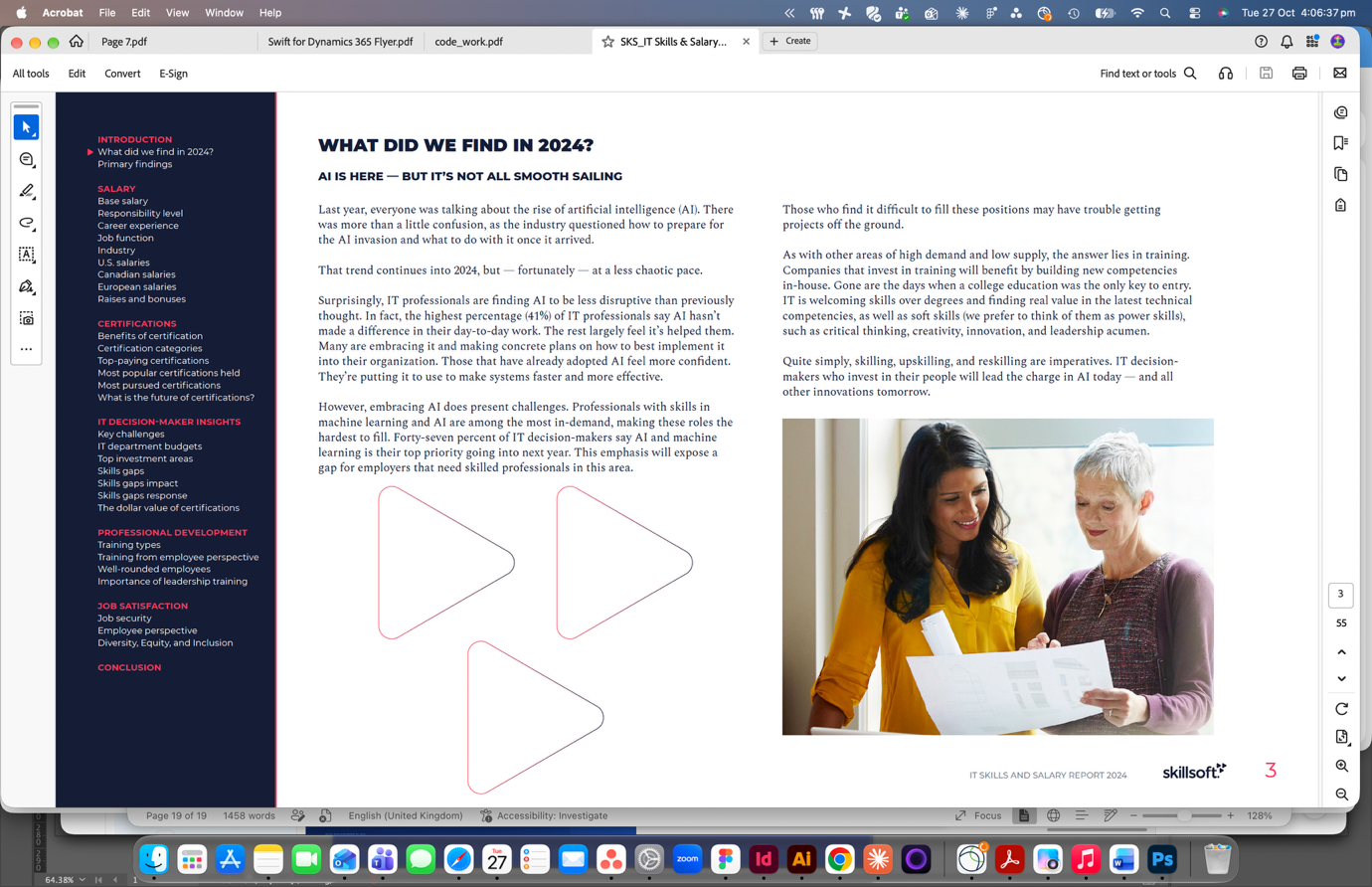
Design for usability and accessibility

Long reports need to be easy to navigate. Each edition removed accessibility issues and added quick links between sections and home, plus a persistent side or bottom index so readers always know where they are.

Report navigation
Fig 3.5 — Persistent index and quick links
{{ a.cap }}
{{ a.cap }}
05 — Outcomes
12%Increase in brand awareness across supported brand initiatives
On time, every timeEvery report delivered within tight timelines despite many stakeholders
12-month assetEach report used across channels for the full year
Learning & iteration

Planning which sections become standalone assets during the design phase makes the year-round campaign far easier to execute. Each edition improved on the last, turning dense reports into documents readers navigate in seconds rather than scroll through.

Case study 04 / 04
04.

Event
Experience Design

Designing booths and event ecosystems that communicate at a glance.

CompanySkillsoft
DisciplineEnvironmental & event design · Spatial communication
My roleEvent graphics lead, booth concept and layout to every collateral piece
Partners3D design artist · Event & marketing teams
Challenge

Booths must communicate instantly, from a distance, in a crowded space, to people walking past.

Strategy

Design for distance, angles and people, then validate every panel in 3D before anything is printed.

Outcome

A complete event ecosystem in one brand language, improved after every show.

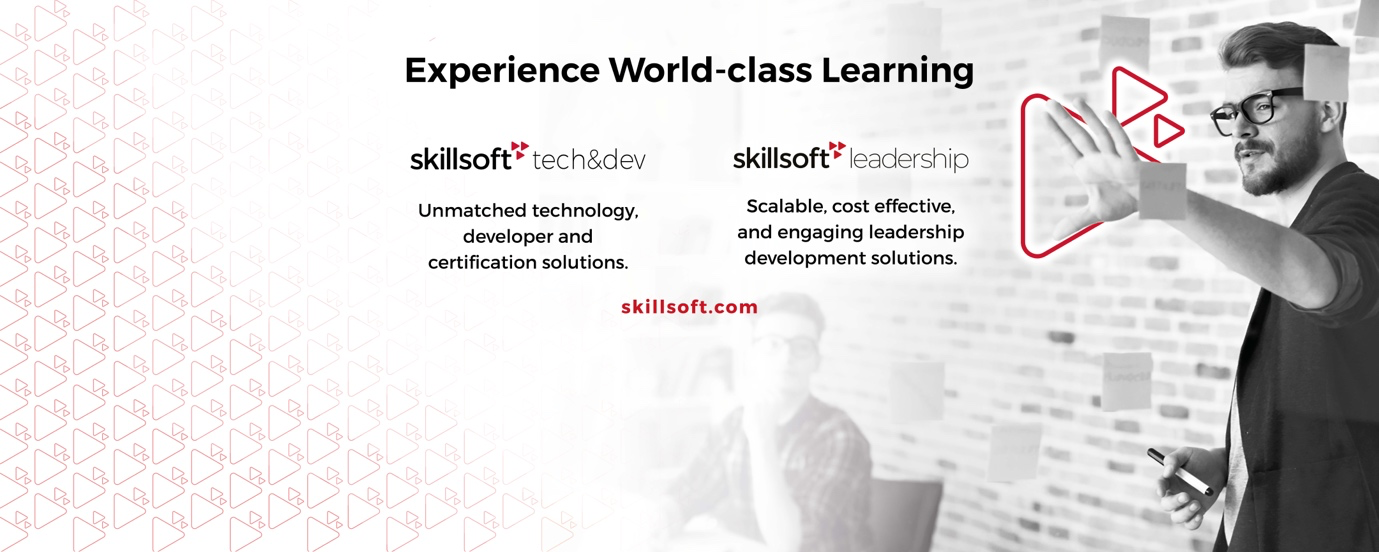
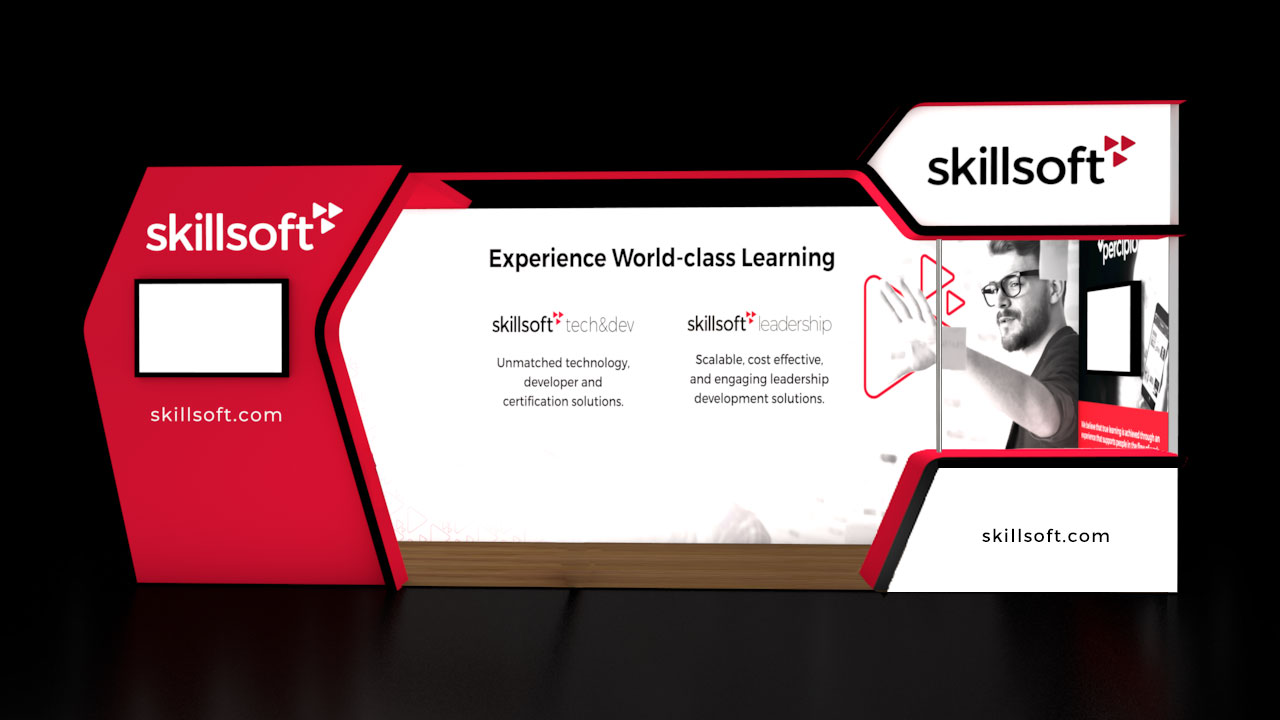
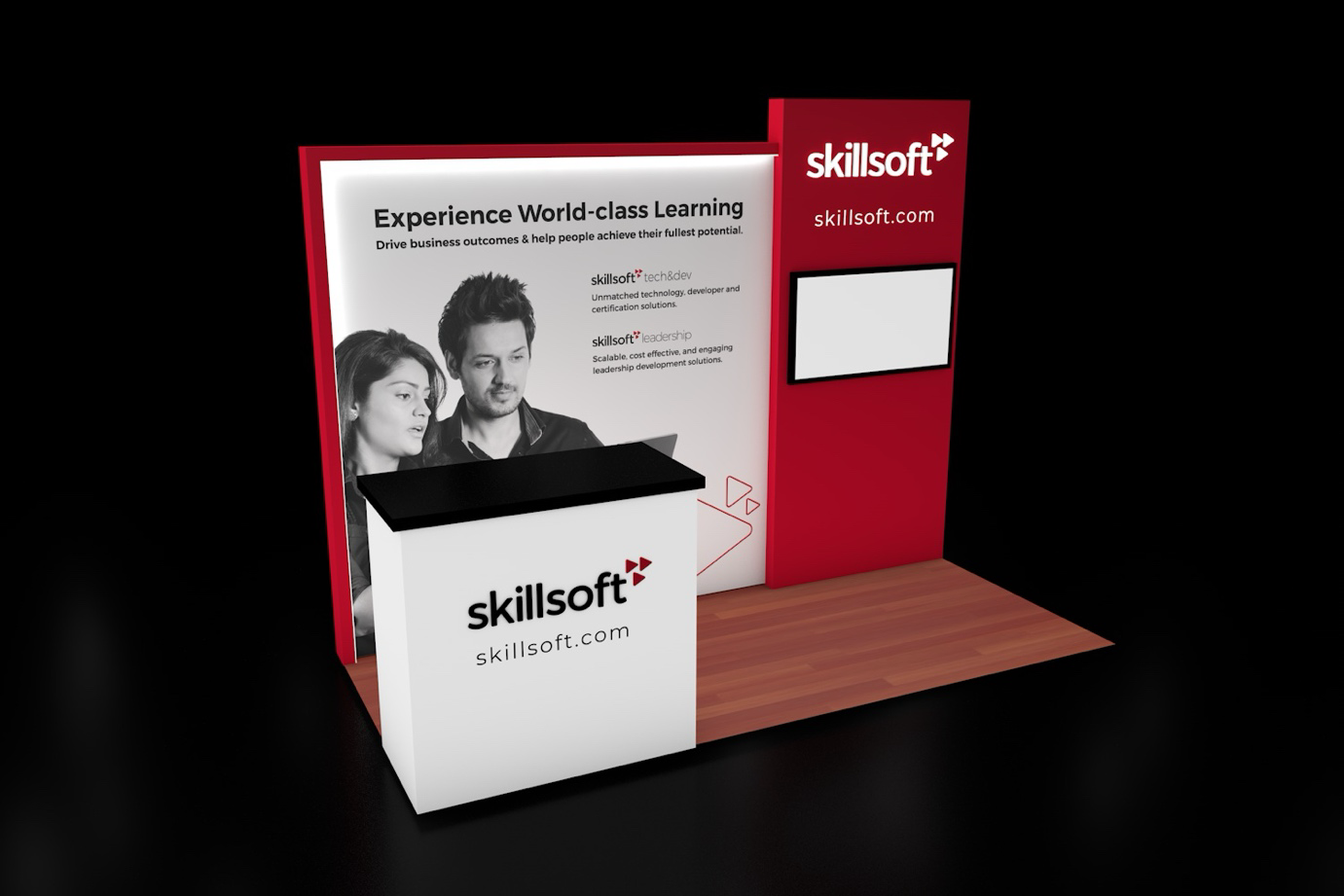
Booth render
01 — Context

Corporate event booths carry real constraints. And the booth is only one piece: an event needs a full ecosystem of on-site and promotional assets, all speaking the same brand language.

MessagingAligned to the event’s theme and audience
Word countMinimal. Too much copy makes a booth unreadable
ReadabilityBold from afar, impactful up close
PlacementWorks open on one side, two sides or a corner
VisibilityKey messages clear of people standing or sitting
02 — Insight
A booth is read from a distance, at an angle, with people standing in front of it. Design for the event floor, not the screen.
03 — Approach
1

Design for distance, angles and people

For each layout I mapped which panels could carry messaging, where standees could showcase products, and how to keep the main message clear of people inside the booth.

Booth elevation
Fig 4.1 — Back-wall elevation with message hierarchy
2

Build from scratch when needed

From an empty floor space, I planned the full layout: which structures to use, where they sit and how visitors move through the space.

3

Validate in 3D before production

With a 3D artist, we modelled the booth and placed copy and graphics on the render to check visibility, hierarchy and blocked angles before anything was printed or built.

3D render
3D render
4

Design the whole event ecosystem

Name tags & lanyardsHandouts & bookletsBooth TV videoStandees & product displays
Booth environment
Fig 4.3 — Full booth environment
5

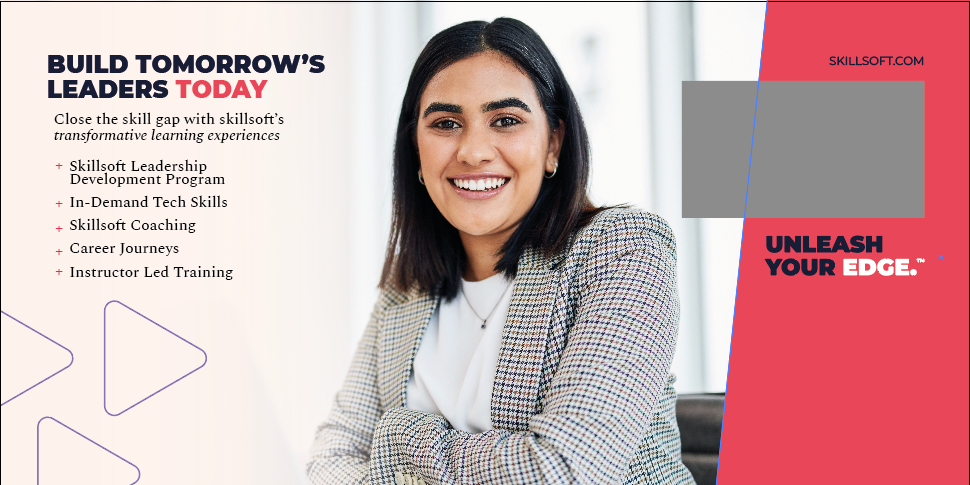
Promote the event, not just the booth

Multi-platform promotion drove traffic: booth-number announcements, discussion-panel promotions and pre-event social content.

Promo banner
Fig 4.4 — Event promotional banner
04 — Artifacts
{{ a.cap }}
{{ a.cap }}
05 — Outcomes

A booth design is only proven on the event floor. After every event I review booth photos and attendee and team feedback against three questions, and each review feeds directly into the next design.

Q1Could the core copy be more prominent?
Q2Did any structure block an important angle?
Q3What should change next time?
2014 — 2022

Graphic
Archive

Identity, social, print and illustration from freelance consulting and earlier roles, for clients including Adani, Photon Instruments and Akshi Tech.

01.

Logofolio

02.

Digital & social

03.

Print & packaging

04.

Illustration & visual facilitation

About me

Nidhi Gupta

Brand & Creative Lead · Design Strategist · Brand Experience

I’m a brand and creative leader with 11+ years shaping brand experiences and multichannel creative for global organizations. I translate business objectives into visual storytelling, integrated campaign concepts and creative systems that scale across B2B and B2C.

I lead from strategic briefing and concept through execution and optimization, with strengths in brand governance, creative operations, team and agency leadership, stakeholder alignment and data-informed experimentation.

How I think about design
01.Audience before assetEvery brief, message and format starts from who it’s for and what they need.
02.Systems over one-offsPlaybooks, campaign packages and governance that let teams scale without losing quality.
03.Test, learn, iteratePerformance data and real-world feedback shape the next iteration.

From past
to present

2007B.Tech, Computer Science, Rajasthan University
2014Graphic & Web Design, MAAC Hyderabad
2015Creative Designer & Visualizer, Capgemini
2016–22Freelance brand identity & design consulting
2017Graphic Designer, SumTotal; Senior Graphic Designer from 2020
2022Marketing & Design Specialist, Skillsoft · MICA certificate in Managing Brands
2023 — NowBrand & Creative Lead, Skillsoft | Codecademy
Capabilities
Brand strategy & governanceIntegrated campaignsCreative directionCreative operationsTeam & agency leadershipCreative experimentationEditorial designEvent & spatial design
Tools
Adobe Creative CloudFigmaPowerPointBrandfolderStensulInstapageCerosMotionAsanaClaudeGenerative AI tools
Brand strategist.Creative lead.Campaign architect.Experience designer.Team builder
{{ lightCap }}
{{ lightCap }}Esc / click to close ✕